| Internal
Combustion Engines offer significant advantages over external combustion
in many applications, particularly automotive where there is a need for
rapid variation in power output, which can be achieved by changing the
fuel supply rate. However, for continuous operation with extended
service intervals, as required for domestic heating systems, the
challenges facing ICE are formidable; until recently it was considered
that the cost of the components required to achieve the appropriate emissions,
efficiency and reliability parameters would be excessive.
Early products, based on automotive ICE
technology, operated with some success in niche applications, but have
been unable to overcome these technical challenges and have been beset
with high service and operating costs. The products mentioned
below, however, have all been developed for long life with relatively low service
intervention and incorporate a range of features aimed at achieving the
performance desirable for domestic and small commercial applications.
For further discussion of the relative
merits of these engine types see section on papers.
|
|
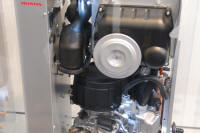
Honda’s
small household cogeneration unit is
the world’s first practical cogeneration unit for home use; in its
current configuration it is not suitable for indoor installation.
The incorporation of catalytic converters and an elaborate acoustic
attenuation system, together with novel engine design, have overcome the
principle limitations of ICE design, namely noise, emissions and service
intervals. However, the cost of
these additional components results in a very high installed cost, which
is difficult to justify on economic grounds. In the Japanese
market, where thousands of these units have been installed, high
electricity prices and capital grants greatly improve the economic
viability for the end user.
The unit is now being marketed by
Climate Energy in the USA and development of a European model is
believed to be being undertaken by German boiler manufacturer,
Viessmann. |
Developed
and manufactured by the Baxi Group company Senertec GmbH, the DACHS is a
European manufactured packaged mini-CHP unit based on reciprocating
engine technology. Operating reliably and successfully across Europe for
many years, the DACHS is proven technology and has become an established
choice in mini-CHP. Over 8,000 units have now been installed by Senertec
GmbH, and its partner network, mainly in Germany.
Its primary application is for small
hotels and apartment blocks (e.g. sheltered housing) where there is a
continuous electrical and thermal baseload. The resulting high
annual operating hours provide the substantial savings required to pay
back the relatively high capital cost.
However, it is physically too large and has too
high an electrical output to be suitable for anything but the largest
family homes, or those with swimming pools. |
Based
on the Marathon gas engine designed for dry operation and can be modulated
to match electrical load. This feature is believed by its
developers to offer significant benefits over its competitors.
However, the high capital cost of this products
will require very high
running hours at full load in order to generate sufficient electricity
to recover the investment. It is only in remote (off-grid)
applications where this feature offers significant benefits.
Ecopower has been acquired by Vaillant, the
German boiler manufacturer who are also developing the Plug Power based
fuel cell micro CHP unit.
|
Not
really suitable for individual homes, but, according to the UK
government (DTI) official definition of "microgeneration" as being
anything below 50kWe, it is "micro CHP".
This product incorporates a package of components including the
engine/generator, a supplementary boiler, heat exchanger and integrated
control system. Rather uniquely it offers a sophisticated control
with the option of heat or electrically led operation, with the engine
being capable of a wide modulating range. It is ideally suited to that difficult
to address middle ground between individual homes and multi-occupancy
buildings and is included here for those with an interest in
small apartment blocks, sheltered housing etc.
Both diesel and gas-fired versions are available, each with electrical
output around 15kWe. The gas-fired model is based on a
Toyota
engines renowned for reliability and long life, whilst the diesel and
biodiesel models use Deutz engines. |
The Yanmar product was recently launched
in the UK market following installation of around 600 units in
Japan.
Unlike the EC Power unit, Yanmar offer a
packaged system which is somewhat less flexible than the EC Power
unit, although this should be offset by their offering the product
in a range of sizes between 5-25kWe.
In late 2007 they initiated a 3
year demonstration programme of their biodiesel variant which will
eventually become available with an output of 25kWe. |