|
The
Rankine cycle, like the Stirling cycle is an external combustion
cycle; the combustion process is external to the cylinder
containing the working gas. The Rankine cycle is characterised by
the working gas undergoing a phase change (from liquid to gas) which can
be utilised to achieve high power densities. The most familiar
Rankine engine is the steam engine in which water is boiled by an
external heat source, expands and exerts pressure on a piston or turbine
rotor and hence does useful work.
A number of the products below
make use of this concept. However, one of them (the Energetix
Genlec)
is an organic Rankine engine which uses an organic fluid (a
refrigerant) and operates at temperatures and pressures much closer to
conventional heating and refrigeration appliances. This has the
significant advantage of allowing the use of conventional, mass produced
components and eliminates many of the technical challenges of steam
engines. However, the relatively low temperature differential between
hot and cold stages of the cycle, limit the Carnot (theoretical)
efficiency; in practice efficiencies in single digits are commonplace.
For further discussion of the relative
merits of these engine types see section on
papers.
|
|
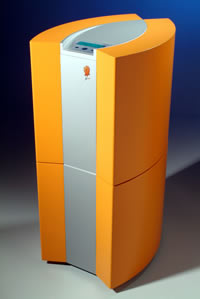
The
Energetix Genlec unit, is currently the only truly wall-mounted micro
CHP anywhere in the world.
In effect, it is a refrigeration unit
working in reverse, using the expanding working gas to power a scroll
expander (compressor).
In theory, the ORC (Organic Rankine Cycle) design
can be constructed using off the shelf
components for the majority of the appliance, leading to low production
costs. However, this product now makes use of bespoke components
intended to optimise the performance.
It's relatively low electrical efficiency
means that it produces less electricity for a given heat load than some other units, although
this should be compensated for by the expected low cost.
In 2012, Energetix established an energy
supply company, Flow Energy, which offers a package including gas and
electricity supply as well as the micro CHP unit.
In July 2013,
having gained 40,000 customers, the energy supply company ceased
customer acquisition activities to focus on product commercialisation.
|
The
Climate Energy unit also uses a scroll expander, with benefits of
simplicity and potentially low manufacturing cost.
However, the
use of steam as a working gas raises technical challenges regarding
reliability and safety. Against this, the developers claim that
the thermodynamic properties of steam permit high heat transfer rates
(resulting in compact heat exchangers), tolerate leakage and have no
inherent material risks. It is also non-toxic and thermally stable
which, combined with the zero cost make this a competitive technology.
Climate Energy LLC have
also launched
the Honda ICE based unit in the USA and it is uncertain as to whether they
intend to continue development of their external combustion unit.
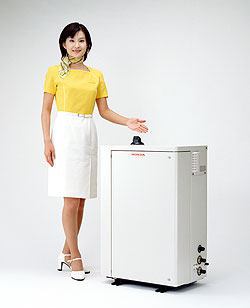
Illustration shows the Honda Ecowill unit.
|
Otag have developed a steam powered unit,
utilising a single cylinder with two opposing pistons. An integral
linear generator converts the reciprocating motion directly into
electrical energy with variable output 3 phase output.
Further details including an excellent
animation of the cycle are shown on the Otag website.
Although originally intended to be wood-pellet fired, the unit is
currently available in Germany as a gas-fired product only.
The company website provides an
illustration of the economic benefits, including tax rebates, which
deliver a net benefit of around €1000 annually.
The product has been branded the "Lion
Powerblock". |
The
Enginion Steamcell unit was initially developed as a small commercial unit with a
power output of around 50kWe. It then evolved into a unit
more appropriate for small apartments and hotels; the target power
output of ~5kWe made it unsuitable for domestic
installations.
Enginion was placed in receivership during
late 2005. |
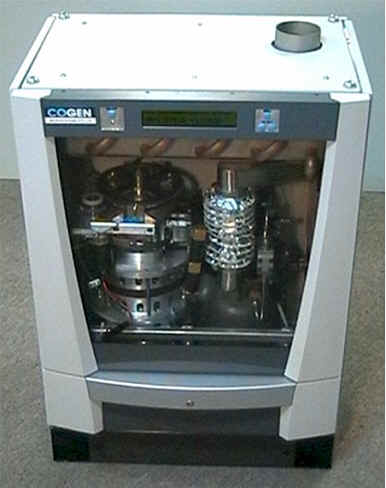
The
Cogen Micro unit, developed by an engineering consultancy (Applidyne) in
Australia is unusual in that it uses reciprocating (single piston)
technology.
Historically the very low efficiencies achievable at
reasonable temperatures and pressures have not been attractive.
However, novel injector design has enhanced the performance of prototype
units which may lead to an ultimately viable product.
In 2011 Cogen Micro appear to have abandoned
this novel design in favour of an Organic Rankine Cycle design similar
to that from Energetix, the principle difference being that a
reciprocating rather than scroll expander is used.
|



_small.JPG)