|
PEM fuel cells had for some time been
considered the leading fuel cell technology for domestic CHP
applications. It has been suggested by some that the exploitation of
this technology for automotive applications would encourage the
development of low cost PEM units for use in stationary
applications. The same logic, however, has not brought the benefits
of low cost ICE technology to micro CHP and it is difficult to see
how the requirements of the automotive industry for low cost, short
life, high power density, flexible output motive power units can be
transferred to micro CHP where requirements for long life, low
service and high efficiency are paramount.
However, the majority of fuel cells currently installed are of this
type, albeit heavily subsidised by the Japanese Government.
Performance to date has been variable, with some systems delivering
disappointingly low savings. Both electrical and overall
efficiencies have been relatively low, but for Japanese market
conditions, PEM technology with its ability to modulate and cycle
relatively quickly is still being pursued as a viable technology.
|
|
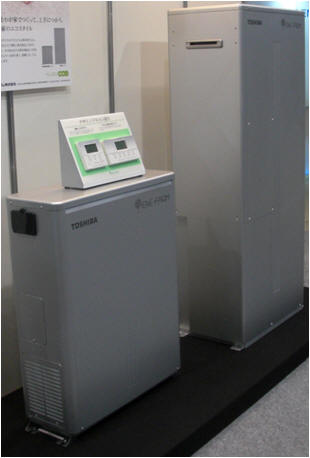
In common with other Japanese ENE FARM
participants, Toshiba have now launched a nominal 700We PEM micro CHP
with sales exceeding 4000 units in the subsidised Japanese market.
It is equipped
with a supplementary heater to provide operational flexibility,
incorporated in a separate cabinet which also houses the hot water
storage tank.
A service life of 80,000 operational hours,
equivalent to 10 years, is anticipated.
In 2011, following the Great Japan
Earthquake, UPS functionality was added to the product, considerably
accelerating sales. |
Baxi Innotech announced a collaboration with Ballard in March 2009 to
further develop their PEM package based on previous work by European
Fuel Cells (previously Hamburg Gas Consult, formerly owned by EON AG, the German utility).
EFC had previously demonstrated a number
of prototype units in apartment blocks in Hamburg, but Baxi have since
demonstrated individual home units in UK and Germany with an electrical output of
2kWe, although current versions have a reduced electrical output of 1kWe.
In 2009, Baxi demonstrated the Gamma version
of their product utilising the Ballard PEM stack, and continue development and demonstration
of their PEM technology, most notably within the German
CALLUX
programme. |
Following extensive development activities
on fuel cells based on university designs, Viessmann abandoned in-house
PEM fuel cell development in 2010.
In September 2013 they announced their
partnership with Panasonic, with the
intention to integrate the market proven Japanese fuel cell stack into an integrated
micro CHP package.
It was announced that the product, similar
to the Japanese unit in performance, will become available from 2014 at
an installed price of €35,000.
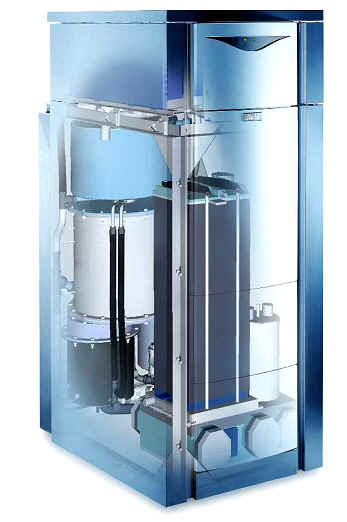
The Vitovalor 300-P product comprises two units, the fuel
cell itself in the left hand unit and the hot water store, buffer tank and auxiliary
boiler in the right. |
Elcore have developed a high temperature PEM
fuel cell with an unusually low electrical output of only 300We.
This might at first sight appear to offer
little economic benefit. However, the relatively low heat output
(600Wt) is able to meet the demand for domestic hot water, so that the
fuel cell can run continuously, resulting in an annual electrical output
of 2400kWh, similar to a Stirling engine based product.
It is intended as an add-on to an existing
heating system, rather than a replacement, so that the capital cost is
relatively high compared with Stirling, but it may be suitable for homes
with low space heating requirements or where domestic hot water alone is
required. |
|
Availability
Japan 2009
$20,000
Europe 2015? |
Availability
Field Trials in Germany & UK
Series production and market launch planned for 2015
|
Availability
Germany April 2014 €26,000 supply only,
€36,000 including installation and VAT
EU 2015
|
Availability
2013 First field trial installation in
ENEFIELD project
€9000 installed |
|
In 2012, Ballard Power Systems, the
Canadian PEM supplier, extended its controlling interest in Dantherm
Power with Dantherm AS, acquiring Danfoss' shares in the joint
venture.
So far Dantherm only offer short
duration run time back up power products fuelled by Hydrogen or
Methanol.
The Hydrogen fuelled products are
available in 1.7, 2.5 and 5kWe configurations, whilst the Methanol
version is available in 2.5 and 5kWe only.
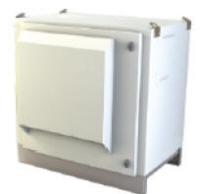
The image below is of the outdoor unit.
As power only (air-cooled) products
these are of course not micro CHP. However, Dantherm is
participating in a Danish Government sponsored field trial of micro
CHP in residential applications. |
Following large scale technical demonstrations of products from a number
of manufacturers in the Japanese ENE FARM project, a few
companies (foremost Panasonic, Toshiba, ENEOS) have launched products
down-rated from 1kWe to around 700We (in order to minimise export).
All are equipped
with a supplementary heater to provide operational flexibility,
incorporated in a separate cabinet which also houses the hot water
storage tank.
Products from each of the above
manufacturers are now available in Japan at the equivalent of €25,000
with a Japanese government subsidy of around €7,000.
The Panasonic version now comprises two tall
cabinets with a reduced overall volume.
In 2012 Panasonic announced the
establishment of a European R&D facility. |
Following large scale technical demonstrations of products from a number
of manufacturers in the Japanese ENE FARM project, a few
companies (foremost Panasonic, Toshiba, ENEOS) have launched products
down-rated from 1kWe to around 700We (in order to minimise export).
JX also offer an SOFC based product with
similar output, but higher electrical efficiency for exactly the same
price.
In 2013 JX are believed to have abandoned
PEM technology in favour of the higher efficiency SOFC product. |
Vaillant,
the European boiler manufacturer, established a partnership with PlugPower (USA) to integrate the PEM stack into an micro CHP
system. However, with a nominal electrical output of around 5kWe, the focus
was on multi-family homes
(small apartment blocks) comprising 4 or more homes. The fuel cell
is connected to a thermal store and a supplementary boiler, allowing the
fuel cell to operate more or less continuously.. A number of these units
were trialled as part of the EU funded VPP (Virtual Power Plant)
project.
Vaillant are now working with Staxera on
SOFC technology having delayed plans to take their PEM technology to
market. |



3.jpg)
%203.jpg)
.JPG)
2.jpg)
.JPG)